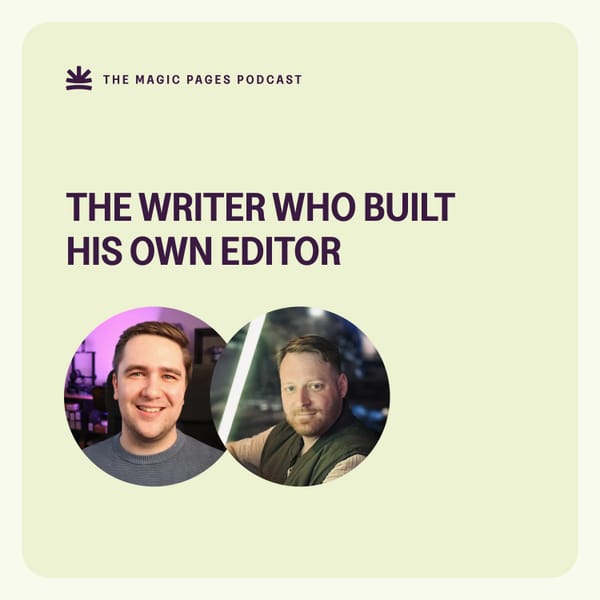
About this episode
Justin Cox has written online since the late 90s, co-founded The Writing Cooperative on Medium, and has owned JustinCox.com for more than twenty years. Every Wednesday his Write Now series features another author's writing process. It started with a cold email to Andy Weir and has reached almost 300 authors since. Those interviews became his book, Write Now, whose advice included a line Justin has since taken back: find a writing app that's good enough and stick with it.
Earlier this year Justin set out to test whether AI really makes software-as-a-service obsolete, and built the writing app he always wanted with Claude. The result is em, a Markdown editor for Mac, iPad and iPhone that syncs with Ghost and iCloud. Jannis and Justin talk about why he left self-hosted Ghost for Magic Pages, the bug that wiped his drafts, managing an AI agent like an intern, and why em's AI features give developmental feedback instead of writing anything. They also get into whether on-device models will make all writing sound the same, where writers should compromise on their tools, and why every writer has to draw their own line on AI.
Chapters
- 0:00 — Welcome — Justin Cox, writer and app builder
- 0:35 — From a late-90s blog to The Writing Cooperative
- 2:24 — Twenty years on one domain
- 5:02 — From self-hosted Ghost to Magic Pages
- 5:51 — One-click updates for self-hosted Ghost
- 8:11 — Write Now: 300 authors, starting with Andy Weir
- 11:39 — Andy Weir on writer's block
- 14:15 — Bestselling authors write in Word
- 15:27 — Simple tools, from TextEdit to Microsoft Publisher
- 18:08 — Why Justin stopped writing in Ghost's editor
- 20:08 — Testing whether AI kills SaaS
- 22:16 — em today, and the iPhone Duo
- 23:26 — The day Claude deleted the drafts
- 26:04 — Starting over: a MarsEdit for Ghost
- 27:25 — Managing AI like an intern
- 29:02 — Why em: a Mac-assed Mac app built for privacy
- 31:00 — On-device Apple Foundation Models
- 32:04 — AI as a developmental editor, not a ghostwriter
- 35:31 — Will on-device AI make all writing sound the same?
- 37:33 — Where writers should compromise on tools
- 39:05 — Drawing your own line on AI
- 42:20 — AI crawlers and paying for training data
- 45:29 — Turning Ghost cards into Markdown
- 46:16 — Would Justin build another app?
- 48:40 — Wrap-up
Links & mentions
- JustinCox.com — Justin's site, on Magic Pages
- em — Markdown Writer & Editor — the app's website
- em on the App Store — for Mac, iPad and iPhone
- I Built the Writing App of My Dreams — Justin's launch post for em
- Introducing em on the Ghost forum — where Justin fixes bugs as they're reported
- Write Now (Second Edition) — Justin's book on starting to write
- Write Now interviews — the weekly author interview series
- Write Now with Andy Weir — the very first interview
- The Writing Cooperative — the Medium publication Justin co-founded
- How to Move to Ghost in 2025 — Justin's post on moving from self-hosting to Magic Pages
- Stop Choosing Sides on AI — Justin's stance on AI and writing
- Casey Newton on building a personal app with AI — Platformer; where the 'managing an intern' comparison comes from
- Mac-assed Mac app — Brent Simmons on where the phrase comes from
- MarsEdit — the desktop blog editor em takes its cue from
- AI crawler controls on Magic Pages — blocking AI crawlers at the edge
- Cloudflare: Pay per crawl — letting AI crawlers pay for access
- Episode 9 — Meet the engineer behind self-hosted Ghost — Austin on one-click updates coming to self-hosted Ghost
Justin is a Magic Pages customer and affiliate — something he discloses on his own site too.
Transcript
Jannis: Hi and welcome to the Magic Pages podcast the podcast where we sit down with the people building hosting and publishing on Ghost I'm Jannis the founder developer behind Magic Pages. And today I'm here with Justin Cox writer and author of Write Now [co-]founder of The Writing Cooperative and most recently the person behind the writing app called em Justin it's great to have you on the podcast. Hello.
Justin: Thank you so much Jannis. It's great to be here.
Jannis: Justin. For everybody that doesn't know you Can you quickly give us an introduction of who you are what you do and why you think I invited you onto this podcast now?
Justin: Yeah, great question. So I have I've been a part of the writing community Really in earnest for about geez about 15 years now feels like forever in reality. I started blogging online in the late 90s Showing my age a little bit. But I started really back up with it with a serious passion in the early tens and that's when I co-founded The Writing Cooperative, which was a massive publication on Medium was really dedicated to helping writers grow and the short version there is we all came together to help each other write better and. Used the platform and really kind of used some I would call them bugs of the platform to take advantage of some community features that weren't really intended but we made them that way and helped each other essentially and the publication grew and grew and then Medium patched the bugs and and I started really focusing on my own writing and connecting with my audience and my writing tends to take a focus on creativity and How to be creative and how to tap into your creativity but also then how to use the tools and technologies that exist today that can help enhance our writing and be.
What I like to call part of the writing toolbox for for creators. And so I've written probably on every single platform that exists or has existed in the last 20 years playing with all the different features and functionality and so Medium to Substack to essentially my own self-hosted Ghost and then to Magic Pages when I realized I was tired of being a web Administrator and and yeah, and so now I've been my latest project is building this writing app Which we'll be talking a lot about I'm sure.
Jannis: So I first heard from you when you reached out to Move your self-hosted Ghost blog to Magic Pages and that's when I learned about all the other things that you know. You were writing on Medium that you had The Writing Cooperative. And the one thing that immediately just hit me is that you are one of the people that I. Always mentioned when I say it's important to own your domain name. For example, you've owned your domain.
I think you put it on your blog since 2005. Yeah, and I bet it's seen a bit of history Can you just walk us through that? What has that domain seen so far?
Justin: So yeah, technically the WHOIS says 2005. But I think I might have owned it earlier I've purchased my name JustinCox.com way back when and there has been so many iterations of my website on that from the early blog to a point in the the late aughts when I got tired of my Personal blog and turned it into just a landing page There was points where it just pointed to my Medium Site early and on it pointed to my Tumblr site back in the day then Eventually sometime in the mid teens or so. I started to realize that all of these platforms Medium Tumblr Substack and you can take that further into Facebook or whatever as well. They thrive on having our content that we create locked into their ecosystems.
And and even though I could point my domain to Medium and had all my writing there that I didn't really have any control over. It I didn't have a lot of this kind of came about when I when honestly when Twitter shut down or what's. Purchased by Elon Musk and everything changed and I realized that platforms come and go and. And I really needed to invest in my own Ecosystem if you will. I originally spent a lot of time moving my website content to self-hosted WordPress Which I used in the past and was relatively familiar with I had that running for about a year.
But then realized that it didn't really Support the community and connective features that I was used to at the time. I was writing it a weekly newsletter for The Writing Cooperative that at its heyday was going to something like 25,000 people weekly and I liked that way to connect directly with my writer or my audience and folks responded and I had fun conversations and the reply chains and so I wanted that kind of functionality and that led me to finding Ghost and so I Installed and ran Ghost on my self-hosted domain for I guess probably about a year or so and. For those listening. I'm sure they know Ghost is great. It's a fantastic platform.
I love it the behind the scenes for updates and. Infrastructure changes and all that kind of stuff is Not as simple as I was hoping it to be and that's where I found Magic Pages. And so for the last I don't know was been two or three years now. I think JustinCox.com has been on Magic Pages and I have never been happier Being able to focus just on my writing and what goes on to the site than rather than all the behind the scenes stuff That's necessary to keep it running.
Jannis: Well, I mean, I'm happy to hear how yeah funny enough Like I read through your migration post when you mentioned that you migrated to Magic Pages earlier today and you mentioned that the one thing that really annoyed you was the updates that you had to SSH into your server and run an update of Ghost on your command line and the last guest on this podcast was Austin from the platform team of the Ghost Foundation and. He Mentioned that they're gonna tackle exactly this that one of the goals for Ghost 7 is to solve this issue and move everything onto a platform where you can essentially just update Ghost from The dashboard like it's on WordPress since I don't know like ages basically.
Yeah. Yeah, we are getting to a point where that convenience will be there. So Maybe that opens up self hosting for a lot more people again. I just thought it was like really funny how Austin mentioned that last week and I read a bit about your on your blog like Earlier today how all of those things connect. So you weren't the only person that had that issue basically.
Justin: Working with writers for so long especially writers on. Platforms like Medium where it's super simple to just get started that's one of the things that I've realized is I am not afraid of tackling new technologies or learning new processes and the SSH and command-line Connectivity into the website was not something that scared me. It was just tedious but so many writers that that kind of step would be a bridge too far. For most of them. Yeah, and so it's nice to hear that they are looking into that to make that easier, but that's also Magic Pages makes that really easy for folks like that to be able to just click a few buttons and get going and still have Infrastructure that they control and their own domain and all that kind of stuff Which that's how I found you and very glad that I did.
Jannis: I'm sometimes very stuck in the let's say developer community in the tech community. But it's the one thing that we always remind ourselves as well. I think not just of Magic Pages, but also different managed hosting providers including Ghost(Pro) for example That is wild to expect someone to move the writing to Ghost and having to deal with all of those things on the side. Yeah, can you tell us a little bit about what you're currently writing? You have a newsletter that's called Write Now That's also the title of a book that you published, right?
Justin: Yeah, I. So there was a time until about earlier this year that I was writing. I was actually publishing twice a day or twice a week Sorry, my newsletter which has had various names over the years This Just In, Write Now, was on Tuesdays and then on Wednesdays my Write Now interview series with authors publishes and I've. Taken a little bit of a hiatus on the weekly newsletter writing it's more kind of a as My brain has things to say essentially for the last couple of months and part of that has been my focus on building the app also my Busy world outside of writing writing is a it's a the thing I do after work It's not my full-time world these days, but Write Now has been a lot of fun.
Actually, I started it 2019 I believe was when I first started the Write Now interview series and I had this thought There's all these amazing authors that I love their books and I love what they write and how they construct worlds. I wonder how they do it like what tools they use What their environment kind of looks like and so I had this Silly idea at the time that was like I could just email these people and ask them The worst they could do was say no and so the first email I sent was to author Andy Weir who at the time had written The Martian and. Project Hail Mary had not yet come out.
I think Artemis might have been right around the time of coming out and The Martian was one of my favorite books in the the tens and so I found his Publicist email on his website and I sent an email and said interview request and I figured these folks. I didn't want to go into the podcast route because I figured like an Andy Weir It'd be really hard to potentially land a conversation with so I figured I'll make it as easy as possible I'll make it a an email response and within 24 hours his publicist had forwarded the email to his personal email address and he replied to me directly and was like. Yeah, I'd be happy to send the questions over and so I was like, alright, here we go and that turned into what it is now where I've had similar conversations through email with Almost 300 working authors Across the really the globe.
I've connected with some Publicists at the some of the the big I think it's four publishers now since they keep merging with each other. I don't have to go seek authors anymore. They come to me, which is fantastic It's cool to see how people that are Professional writers and some of them are full-time writers like an Andy Weir. R.L. Stine who was a fun one some of them are Part-time authors who have day jobs like myself that then write when they can and still manage to publish.
So that has turned into my longest running ongoing series every Wednesday, there's a new interview with an author and It's cool. Sometimes folks find inspiration from what these people write. I continue to go back to one of the things Andy Weir wrote in that very first interview that. One of the questions I asked authors is about writer's block and What prevents you from writing sometimes and I have lived with this quote for the better part of a decade now. And he basically says he doesn't believe in writer's block. He believes in basically getting your ass off the couch and putting in the work and. And. I'm like, all right, and that has stuck with me that if writing and publishing is something that I want to do the only thing that really is preventing me from doing that is myself and my own kind of belief of lack of time or any of that kind of thing and Connecting with these authors has been a lot of fun and and putting the whole series together has been a fun endeavor Which it led to the book that I wrote and in the first version I think was published in 2021 it was my COVID project and I Figured I had at the time a couple years worth of these interviews and my own decade or so of Experience writing more or less professionally online kind of advice Could I turn around and give to other writers who are sitting in that like, how do I start though?
I want to do this thing. I've got these Ideas, what do I do? How do I start and am I the only person who's getting in my own way kind of concept? That was a fun version to put together There's the second version got published last year with some updates particularly around AI and and that kind of thing. But yeah, it's been a fun journey.
Jannis: I didn't know it was that big that you spoke to over 300 authors now and it's mainly about like the workflow and tools that they use.
Justin: I've never really interviewed people before and so I went, hey, there's the who what where when why and how Questions and so there's a set list of questions that I've asked every single author It's who are you they introduce themselves with some of them provide a lot of detail some of them provide none It's just who they are where they're from it gets into why do you write and there's some sub questions that people can fill in There but what motivates them what drives them how they get into it potentially where they write and when they write that that part is particularly fascinating to me because some of the folks that are part-time writers are talking about how they write around their kids schedules or in The car waiting during soccer practice or after work or whatever it might be and that's pretty interesting what tools what their writing workflow is and tool sets and one of the things that I think I Particularly because I like technology have fallen into is what's the latest and greatest writing app and I'm building one because of that.
But so many of these published highly renowned authors use Word. And just crank out what they're writing in a Word document or a Pages document for Mac folks we sometimes over complicate you getting the ideas onto paper and Some of the tool sets that are the simplest are available to us and then I asked how they overcome writer's block and then what they do outside of writing and That that is also interesting because so many writers Have a hard time answering that question other than to say I love to read and I love to engage with other writing.
And then people that like to hike or have other activities and whatnot. So many it's those who write are locked into this reading and writing world, which I don't think is a bad thing. I just find it very interesting.
Jannis: Yeah, absolutely. I think it comes back to the fact that sometimes the simplest tools are probably the best to just get started. I think I've thought about this in the context of developing stuff lots of times because now in the last Say two ish years or so with AI and everything The developers tend to over engineer their workflows and. Add another tool here and another tool there and in the end if you strip all of it away What you need to write code as a code editor. It's yeah, it's a surface where you add your code Do I need all the blinky blinky around it? Not necessarily and it kind of reminded me of this that if a best-selling author can write their book in Word then maybe. We can write code in I don't know a normal text editor and then deal with the rest later.
Justin: Back in the day of the very first website I ever built again I'm dating myself, but in the the mid ish 90s. It was I'm so far removed from the Windows ecosystem. But in on Mac, there's TextEdit and so whatever the very basic text editor that's ships with the operating system. So whatever the I think it's Notepad on yeah on Windows. Yeah, that's what I wrote my very first website and I typed in the the bracket HTML like the very first text editor that I used and yeah to your point all the the blinky blinky as you said. It makes it sometimes it adds some functionality and features and makes it easier but at the end of the day, we're just we're writing text into a file and. It doesn't have to be too complicated.
Jannis: Yeah, I think but my first I remember that very very Distinctly because it's I misused a tool on Windows for that. I didn't use the Notepad app, but in the Microsoft Office suite of tools there was one tool but it was called the Microsoft Publisher and. It was mainly meant as far as I remember for Designing like flyers and stuff like that.
Justin: Page design. Okay.
Jannis: Yeah. But it had an HTML export. So this is how I created my very first website. They looked horrible. They literally looked like flyers. But then again and and it must have been like 2004 2005 so back then all websites looked like that. So it fit right in.
Justin: That's the thing like everybody has to start somewhere, right? And so you find the tool that makes sense to you before you're like Ready to invest in any kind of extra technology or let me just kind of see Where this goes and so you use what's in front of you and there's nothing wrong with that.
Jannis: Absolutely. Yeah speaking of what's in front of you. You've used Ghost for a couple of years now and had the Ghost editor It's called Koenig. I at least assume it comes from the German word [Editor's note: it's named after Friedrich Koenig, the German inventor of the steam-powered printing press]. So I'm pronouncing it like the German word You've used it's called it the Ghost editor for a couple of years and then at some point you decided something Was wrong with it something didn't work for you.
What was the point where you said? Okay, I'm Need to actually change what I said in my book because in the second version of your book you said choose a writing app That's good enough. There's never gonna be a perfect writing app if I can paraphrase that and then a year later you said no That's not true anymore. I'm gonna do my own writing app What was that point for you where early this year you said I'm gonna do this now. I want to see what I can do better.
Justin: Yes the reality is I have never been a fan of. Writing inside of whatever platform tool exists and so my writing has always started with just a text file and Markdown file on my computer or phone or something to that effect and I have always written the bulk of the content and edited the content on my devices before it ever makes it to Back in the day a WordPress or a Medium or now Ghost once it gets into the Ghost editor is when I would add in formatting or Finalize the links add the pictures whatever it might be.
So it's always been the last mile It's where I polish not where I fully create and so I've used over the years writing apps like iA Writer, Ulysses, or Bear Obsidian for a spell to actually start my writing and to build the outline and kind of fill in the content as I you know, flesh everything out and Earlier this year. I was reading a lot about how AI could be the the killer of SaaS-based Entities and I was like, I don't think that's really true. And I don't think this concept that folks can just use AI to build whatever toolset that they want and that it'll Completely replace the need for any kind of subscription or paid software. I was like, let me test this theory and let me build a writing app.
Yes, I have used AI to help build this writing app. I have I think definitively proven without a doubt that AI is not going to Destroy the software industry or destroy SaaS-based businesses because this has been a in some ways almost impossible feat for what I would consider most people for crazy people like me who aren't afraid of new technology and getting things wrong and breaking things on my device and Deleting most of the content that I had put into it because of accidental Misfires like it didn't faze me Frustrated me a lot at different times, but it didn't really faze me but most people like I said earlier they want to they want to click a few buttons and get started and not have to think through design and architecture and how files are saved and Processed in the background and and so all that kind of led me to this point and and yeah.
In my book, I did say there's no perfect tool out there Find one that works and with all software Ghost included you sometimes have to give up the way that you think it should work and fit to how they intend it to work, you know, a lot of tools add a bunch of customization features and. Flexibility so that you can kind of do to the best extent but still you're playing in somebody else's sandbox. And and so I figured like maybe I can try and build my own sandbox and at this stage em has been out for as we're recording this about a month or so and the version on the App Store is version 1.2 1.3 comes out and. It's set to release when the iPhone Duo comes out.
It supposedly works for that according to the simulator. I guess we'll find out and then I'm I'm currently working on version 1.4 on my phone which has a ton of fun new features that I've been throwing in based on how I have been using the app and and this is one of those things like I Build for myself and I build for kind of what I want and then if other people can find it useful. Then you know Awesome and that's how I've really approached all of my writing over the years. Like the book that I've written is. It's really kind of advice to myself if I would it would be starting now and and I figure there's other people who are in that similar boat that could take advantage of it and Potentially provide some advice and help along the way.
Jannis: You already touched upon it briefly. You said that it wasn't just a I tell my AI bot create a writing app. You don't have a programming background as far as I know but how was the the process for you of getting through all of those hurdles and What happened when I think it was Claude deleted all your content?
Justin: Yeah, so I was using Claude and again. I kind of started this process with okay Is this is this real like can I just tell Claude to build me an app and the reality is you can? And so I had a Markdown editor with about less than 24 hours after I pitched this idea to Claude. I kind of sat down and I said, alright, I want to build a writing app. Is this possible? It's got a I wanted to edit Markdown files and yada yada yada Within about 24 hours. I had the framework of what is today em. It was not good and I didn't know it wasn't good. For about two or three weeks. I was building on top of it and adding more things Until there was just a massive data loss issue where I guess I didn't explicitly say that files had to be saved and so it when you moved from one file to the next it copied all of the content from The new file to the old file and if that meant you started a new Blank document then you lost everything that was in the old one.
And yeah, so that was a fun experiment and. And what adds to that is I've never been really whenever I test new software or. They have built websites or whatnot over the years or as I've been building this this app. I can't be bothered with test folders or test accounts. So I just used my own data and all the things they tell you not to do don't run betas on your live system Don't use your live data. Yeah, I had no I didn't pay attention to that.
So I lost a bunch of drafts I've been working on when that happened and that kind of made me realize yeah, no — nobody This is not for the mainstream Folks to be building apps like this. And so I really did have to take a step back and at that point I. Work with I don't work in development but I'm tech adjacent and I work with developers and software architects and what I've gathered is I think in that systems. Thinking architectural thinking so I kind of had to take a step back a couple weeks into the project and I was like, okay Let's start to think through. You know, okay if I want the files to save How do we build this in a different capacity?
And so I really did start over at one point in the development of the app to really get it to what I wanted and My ultimate goal was that I wanted a Markdown editor that fully connected with the Ghost API so that for those that remember back into the early day of blogging there was this fantastic piece of software for WordPress sites called MarsEdit and. MarsEdit essentially let you run your WordPress site from your computer and Could edit the file or the posts live and could post directly to your WordPress site. And so my original kind of thought process was can I do something similar? With my Ghost site so that I essentially have a full backup of my writing as I write in on my local device then I could send and publish to Ghost and and so I learned a lot about the Ghost API along the way and all of the amazing things you can do with.
It and I really but had to really sit down and map that out and think through alright, so if it's gonna do this, this is how it has to function and. Yeah, it was a lot of fun and it's still a lot of fun That's why I keep throwing new features at it. It's a it's been a journey.
Jannis: I can imagine. I think that really reflects my experience with AI development as well that it can do all of those things but it does take what you say for granted and it just runs with it and. It will still at least for the foreseeable future in my eyes need somebody at the other end that can guide it that can give it guardrails and to actually make decisions because decisions made by an LLM are usually just whatever is the most likely thing to happen or the most likely outcome so it's it's Refreshing and it's good to see that somebody that doesn't come from that background has the same experience that we all having.
Justin: Yeah The I read Casey Newton who writes Platformer just find it fascinating he was talking about his journey with AI agents and whatnot and he Wrote that he likens it to managing an intern and Not everybody wants to manage an intern. and correct the mistakes that the intern makes and all of that kind of stuff and Definitely most people don't want to manage an intern for fun when he wrote that I was like, yeah The my Claude agent that is building this app for me is essentially an intern it's an intern with a lot of knowledge and a lot of skill set but it's still an intern that I got to manage and Correct and Redirect and and whatnot and you have to have that mindset going into it.
Otherwise, yeah You're gonna you might build something amazing, but then it deletes all your data and you're left holding the bag.
Jannis: Can you Summarize why should a writer use em? What's your pitch for somebody to now go out and use that compared to there are a bunch of other desktop apps? That's of writing apps for Ghost, why should somebody go to the App Store and Get your writing app that's called em.
Justin: Em, as in the letters e-m. It's based on em dash, which is my favorite piece of punctuation and I also thought it was a little tongue-in-cheek since I was having an AI build this then AI is Notorious for using a bunch of em dashes, but it's my favorite punctuation mark. It always has been I've been using them forever. I just I love that punctuation mark. It connects different ideas and it's kind of like an aside to me and I that's how my brain works but the reason I wrote em where it has evolved to is. A couple of fundamental components there's a phrase coined and a number of years ago called that's a Mac-assed Mac app and The kind of sense behind that is that it feels like it belongs in the Apple ecosystem.
And that's where I've been ingrained for over two decades now and so I wanted it to use as many system tools and features and design Theories as as possible but the biggest piece was I wanted to focus on privacy, you know. I didn't want to have like a central server or something like that like a like a Day One journal or a Bear that use or Obsidian sync that uses their own kind of. Proprietary syncing mechanism and server. I figured Ghost is the server like that's my that's why I have my Magic Pages account is because that's where it all syncs through and so between that and iCloud That's the the basis for em in terms of syncing so privacy focused.
No data going to some third party. I don't not monitoring any kind of metrics or usage or any of that kind of stuff so privacy. But then also I wanted to take advantage of the Apple foundation models and. So with it started with the last year's releases the iOS 26 releases. But has been greatly enhanced with the iOS 27 releases all of the the modern Apple devices are shipping with what are called Apple foundation models and these are essentially on device LLMs for those familiar with the the Claude kind of structure About what I would equate to like a Haiku in terms of Capability, so they're not doing any kind of reasoning or deep thinking but they power a lot of the ability to suss out meaning and to be able to search differently, but then also to provide some level of feedback and so my my thought process was Can I build an app that?
Uses these foundation models to provide Some kind of developmental feedback for the piece that I'm working on. So kind of going back to my early days with The Writing Cooperative The idea was like I've written this thing. Is it any good? Can I get some feedback and so I have written em in a way that it does not do any writing for you It's not it's not generating text. But if you want to you can turn on the AI features and. Ask questions about the draft you're working on Are you making your point is the the plot clear and I've written it in a way that the prompting is? Question based question and suggestion base to say This looks like it could be stronger.
Have you thought about this or this point could be stronger? Here's a suggestion for that. The idea is that Writers should crave feedback and this is a way to put it right into the app in a way That's private and then for those that want a little bit of extra power There's the ability to connect in Claude API key or Gemini or ChatGPT to take advantage of some of the more powerful reasoning models, but the completely optional component there and since. The 1.2 update for em has taken advantage of all of the new foundation model components that came out with the the iOS 27 releases and They're all it's only getting more powerful and I imagine that as Apple continues to upgrade those foundation models We'll see some of the reasoning and whatnot kind of expand into that and the ability to edit Directly on the device and get feedback which is what's most important to me will be even stronger.
Jannis: Oh, so you're basically Not doing what everybody is doing, which is I don't know. I have an idea or write a post for me. But you built like a little editor in there that can give you feedback and that makes your writing better.
Justin: Yeah, exactly and this 1.4 update that I'm currently working on. I'm having Claude expand on that that feedback engine to not just provide essentially developmental feedback, which is how I've written the prompt but to look for like repeated phrases or overused words things that Sometimes we don't even realize that we already like I I personally know that I say um a lot when I'm talking there There's a ton of them in this interview. It's a.
Jannis: See how it is when I edit it.
Justin: Yeah, it's a good point, but it's how my brain works again It's why I love the em dash. It's a way of kind of Connecting ideas, but there's similar kind of tells like that in your writing and anybody's writing where? We overuse kind of the same mechanics because they're comfortable but that doesn't always mean that it's the best way to format the sentence or the paragraph and so having the on-device model be able to find those kind of things that to me is a Completely private and on-device and no matter how people feel about LLMs and whatnot or AI tools my thought process is that if it's on-device and it's secure Let's use the tool set to help make our arguments and ideas stronger.
Jannis: One thought to that. I'm curious what you think the on-device models. They're rather small models. So they have a very limited Let's say set of training data Do you anticipate that it might run into the risk that all writing at some point? Sounds the same if it applies like the same small training set of saying Oh, no, don't use this because I think that this is a better way of phrasing it.
Justin: Yeah, that's a good question. I guess it all depends on how you use the tool My prompting is like a developmental editor. I don't use it for mechanical editing mechanical editing would be like your spelling, your grammar, your Structure I use it as developmental. So did the point get across? Does the argument make sense and the way that it's structured is it looks at different sections of the piece? And then it looks at the the overall. And it has helped me to to see okay.
So yeah, I laid out my thesis, but then I diverted a little bit and this sidebar kind of came in out of nowhere Maybe I need to add more Depth to that sidebar because it helped but I write in kind of a stream of consciousness flow even though I do outline it Let's see where this goes. And so having the developmental Editor focus with that prompt. It's not so much as like smoothing or making everything sound the same It's more kind of catching like hey This seems like it should have more meat on the bones or this seems like it doesn't fit at all. It doesn't match the Thesis that you're going with to your point. I do think that there's like the Grammarly-fication if you will of writing where tools like Grammarly.
Yeah, they clean up our writing greatly. But there's that sameness that exists. And so I think writers have to be careful about what tools they use and how they use those tools to make sure that their own voice and. Their own kind of what they're trying to get across does not get lost in the editing process.
Jannis: Yeah, interesting. It also kind of ties to another question. I wanted to ask you which kind of comes from your own experience. We already touched upon it. You said in your book find an app make some compromises. There's never gonna be the right app. Now you've built your own app. So all the compromises are out of the way, but you also said that it's not for everybody to just say hey. I want to build my own writing app and it's also Probably another realistic view of the world that we say Okay. We can all create our own version of a writing app our own version of a blogging system Having spoken with so many writers and having written for such a long time yourself What do you think where should authors compromise and where should they not compromise in the tools that they work with?
Justin: For all writers. This has to be a personal decision and. Well, I feel like I have built the perfect writing app for me. I am NOT I'm not going to go ahead and say that this is the perfect writing app for all authors or all writers I like everybody has their own kind of What they're looking for in a tool set and that there's nothing wrong with that That's why there's a billion different options out there. And so I think all writers have to find What makes the most sense for. Them to use whether it's hey, Word is good enough for me like that. I'm good with that That's fine If that works for you that works for you Writers who want to go a little bit further Finding the right tool set and the right component in terms of compromise It's an interesting question because you know when you talk about AI usage and whatnot.
There's there's essentially This there's almost like a line being drawn in the sand There's some folks who are saying I will never ever use an AI to help me write in any capacity and anybody who uses one like I Won't read or engage with their their writing which for those writers. Okay, cool. That's your decision. You have the right to make that decision That's not the decision I made and or will make for myself personally.
But every writer has to find where that line is for them and decide What is the tool that helps enhance my workflow not replace it? I don't think any writers should ever find a tool set that replaces their workflow because then what's the point? But but everybody has to decide What's gonna enhance my current flow and what's gonna let me just strip away and focus on the writing and in many ways that comes back to what we were talking about earlier about why I moved to Magic Pages why I Moved off of Medium into my own website in the first place. I wanted to be able to focus on the words I wanted to write and.
So finding okay, I don't need to spend time updating Ghost and running these SSH prompts once a week and Dealing with the backups and server stuff Jannis is here to make that Thousand times easier for me and but another writer might say, you know what? I like that. I want to have that level of control and and whatnot. And so the same is comes to writing tools and apps and to AI usage every writer has to find where that line is for themselves and.
But the piece there that I think is really important is that when they do find that line They've got to acknowledge that not everybody's gonna make the same choice that they do and that's completely okay that there's a lot of there's a lot of attempt to turn AI usage into an ethical question. And yes, there are so many things wrong with AI and how AI has been trained and power that these tech companies are have been given globally and. We can go on and on for days about all of the issues involved and my choosing to use the tool set is not a It's not an ignoring of the issue or a swiping away of the issue It's more a I feel like the cat's kind of out of the bag at this point if these lawsuits about training data if they win AI's not going away there might be money involved in Going from AI companies to publishing houses and news outlets and whatnot.
But AI tool sets and add-ons are not going away and maybe that's a little bit naive on my part. But that's the stance that I have taken and and every writer really has to Creator in general has to make their own kind of decision as to where that line is for them.
Jannis: I think it it all goes back to choice in the end like you have to make your own choices you have options and I've shared this with you before like I find your view on this fairly refreshing and all the sea of Black and white or looking at the issue of AI black and white and I I've been saying that for quite some time as well Like it's technology that is out of the bag and same with other technologies once it's out There will always be somebody in the world that can use that technology and if we now say, okay We're not gonna use it anymore Whether that is on a voluntary basis that I don't know Anthropic finally reaches an agreement with all the other big AI Companies out there and they stop developing bigger models.
There will always be somebody in Can just be a small village somewhere with a with a computer and they will have access to that technology and it will continue to be developed somewhere and in the end, I think it's great to just have the choice to also address the issues that come or that are present now and. I what I am really Hopeful about is that within the next couple of months or so. We find a framework where creators and publishers can choose how their websites are used in the training data and One thing that's really interesting to me is the fact that you can tell AI crawlers you can use that but you have To pay for it and we'll see how that develops. It's still hard for me to imagine how it's gonna work.
Justin: Yeah Or if the AI companies will even honor it.
Jannis: Yeah, I think the honoring part is the easy part because you can just restrict it so in Magic Pages as well, we have AI crawler controls and a. Another customer actually emailed us earlier this week and asked like oh do I have to put like a hint on my website that? Crawling is not allowed and I just replied and I said just putting a hint there will not stop anyone Like it's it's like, you know having a little sign that says please don't run me over on a highway It's gonna happen at some point.
So what we do is to actually try to identify who's accessing a website and if we say hey, that's ClaudeBot or an OpenAI crawler. We just blocked them before they reach the website and That is the easy part. The hard part is to then say hey OpenAI, you are blocked from this website unless there is this programmatic way where you can pay for access to this content. So if it's important to your training data Here's how you can pay and Cloudflare is developing a framework for this to do that. I know that in Ghost's own source code. There have been attempts to also implement this.
So it's still very far from being released even as an alpha version. But there are those spikes in the source code how this could work and I'm very excited to see how that will shape up in the next couple of months.
Justin, it's been extremely fun to pick your brain on all of these issues to understand how you came to develop em I'm still a bit sad that I can't try it since I don't have a single Apple device here. But I might just ask my wife Mariia to get us a version and we can try it on her MacBook. Because I want to see like how all the on-device LLMs work.
Justin: It's one thing we didn't talk about is there's a lot of Behind-the-scenes stuff because it's taking that Ghost post and turning it into Markdown. So that you can write in Markdown and then converting it back to what the Ghost API accepts All of those, you know, all of the different Ghost cards editor cards the all the different features exist in Markdown which was quite a feat you want to talking about the architectural component If you get an opportunity to play with it. I welcome any and all feedback and but it's been a lot of fun for me to really kind of to put together.
Jannis: Yeah, let me snatch Mariia's MacBook and I'll play around with it a little bit. Cool. I have a little question for you in the end now that you've dove into the Ecosystem of building your own app if you had the time Is there any other app where you now say cool now with all the experience? I want to do this next.
Justin: So I'm not gonna say that that hasn't crossed my mind but I don't foresee that being the next kind of focus of my Creative efforts, it has been a journey to get this thing to the place where it is now, which is I think pretty cool but. Building from scratch with an AI tool is it's not easy and and then building an app is in general is just not easy and. Part of those architectural decisions that I had to make was like Okay, if I want this to work on the iPhone and the iPad and the Mac. And all of those while there are more or less unified over the last couple of years there's so many weird quirks to them that are just make all of this that much harder and so a great example is I'm.
Working on right now adding a Calendar feature into em so that you can see when did I write when did I I publish there's a? Some UI for the calendar like the actual. You know grid of the calendar with the days and the weeks and all that kind of stuff for iPhone and iPad. But not for Mac and just like weird little stuff like that's like I don't know how Developers do it and they deserve more credit and praise than they get because I'm just talking about dealing with Mac and Apple ecosystems dealing with Web architecture and every device that could potentially exist or working with Windows and Android is a whole other ballgame. This is just so much that has to be thought through to Make it all work.
And so will I do this again in the future maybe? But right now I think I'm. Going to continue to iterate em until I get it to the place where I feel it's finally Right, and that's part of my problem is never nothing is ever perfect, but it can get there but I'll keep iterating on em and Continue writing and that'll be my creative focus for the foreseeable future.
Jannis: I'm excited to see where that goes if anybody wants to keep updated on em You've created a little website as well for it link to that in the show notes as well. And yeah, if anybody wants to give it a try Justin said he's very Much looking forward to feedback. So send all of that to him He's also very active in fixing bugs I've seen your conversation that you had on the Ghost forums if there are any bugs Justin fixes them. I've seen that live.
Justin: Yeah, this is part of building a You're well aware as you build something that is for public release. There's always going to be things that you you don't see even no matter how many times and how hard you try and Same with writing no matter how many times I might edit something. I'm gonna miss components and and somebody out there is gonna find it and That's part of the feedback process and you adapt and you fix and move on from there.
Jannis: Absolutely. Thank you so much for making the time so early in the day for you Justin. I Really enjoyed having that conversation. We should have a look in a year or so to see where you ended up with em. And yeah for now Thank you for making the time and I wish you a Lovely rest of your day.
Justin: Thank you Jannis. Yeah, it's been a lot of fun. Yeah, let's check back in a year and see what has happened.
Jannis: Yeah, absolutely then. Goodbye. Thank you.