About this episode
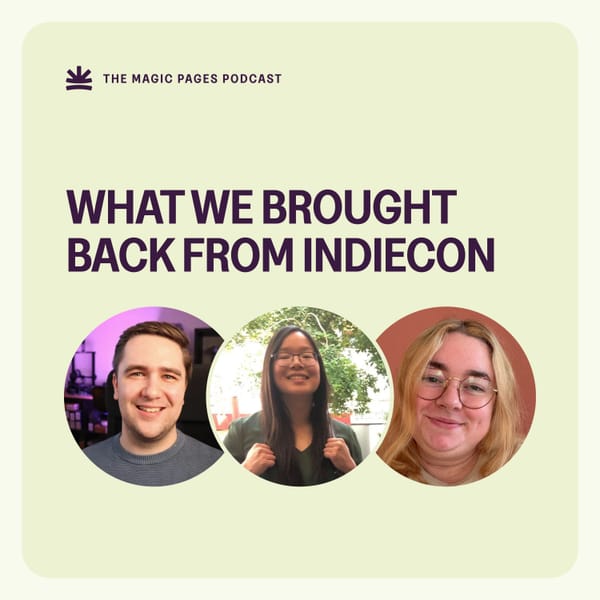
Back in July, Jannis recorded a solo episode about why a web hosting company was sponsoring a print festival. Now the three of them are back from it. Jannis, Mariia and Christine sat down together in one room — three voices, one microphone setup — to talk about the weekend Magic Pages spent at Indiecon in Hamburg: walking into the Gleishalle am Oberhafen, a former freight hall with trees growing inside it, and finding out what a room full of print publishers makes of a hosting company.
They get into the booth and its two reactions (polite confusion, then genuine curiosity), the workshops — bookbinding and a free-writing session about a flying dog, and a newsletter workshop full of print publishers asking where to host — the little magazine they printed and handed out, and the 90-minute Ghost workshop that twelve people walked out of with a real site. The episode ends on the question Jannis brought home from his solo episode: how do you bring the tight-knit feeling of the print scene into the digital world? The answer turned out to be the opposite of scale.
Chapters
- 0:00 — Welcome — why there are three of us
- 1:10 — Christine's first impression of the venue
- 1:38 — "You won't see a guy in a suit here"
- 2:08 — Mariia on the colours and the branding
- 2:43 — The Gleishalle am Oberhafen — a former freight hall
- 4:44 — Did we belong there?
- 4:59 — Christine's newsletter workshop
- 5:55 — What print publishers actually asked
- 6:58 — Mariia's workshops — bookbinding and stencil prints
- 8:49 — Free writing, and the story of the flying dog
- 14:23 — Our booth, and the live email counter
- 15:14 — Two reactions: polite confusion, then curiosity
- 17:08 — Mariia on standing out by being muted
- 21:30 — Jan, the customer who showed up all three days
- 24:20 — Print vs digital — or print and digital
- 28:11 — Christine reads the magazine
- 29:37 — On bias, and writing something that isn't a pitch
- 35:06 — Our Ghost workshop: first post to paid memberships
- 36:28 — The red-and-green paper trick
- 38:29 — Twelve people, twelve Ghost sites
- 39:30 — The print world has a scene — how do we get one?
- 41:26 — Doing the things that don't scale
- 42:46 — Christine: a full-circle moment
- 44:23 — Mariia on physicality, and 30 people in a room
- 46:23 — Dinner with three customers
- 47:49 — Going back next year
- 49:00 — Want a magazine? We'll mail you one
Links & mentions
- Indiecon — the independent publishing festival in Hamburg, 4–6 September 2026
- A Press of Your Own — the little magazine we printed and handed out at the booth — read it online
- Ueberschwarz — Stephen Palmer's non-fiction publishing house, at the booth next to ours
- DACH Magazine — Viktoriia Spalek's Berlin-based magazine for contemporary Ukrainian art and poetry — they ran the free-writing workshop
- Literarische Blätter — the nonprofit whose members came back the next day for more magazines — Mariia half-remembers the name in the episode; it's netzwerk junge literatur e.V. from Leipzig, who publish young authors born after 1990
- Casual Friday Club — Jan's project — he came to the booth all three days and helped us sharpen it
- REFIRE — Charles's publication on German real estate finance — another of the three customers at the Saturday dinner
- Ghost — what the workshop built on
- Magic Pages Open House — the recordings people mentioned having watched
- Magic Pages acquired Gloat — Dan's business, mentioned in the conversation about community
- Episode 4 — A Web Hosting Company at a Print Festival — the solo episode this one follows up on
- Episode 5 — Building a Ghost site with no Ghost experience — Mark, one of the three customers at the Saturday dinner
- Episode 1 — What is Magic Pages? — Mariia's episode
- Episode 2 — Our Very First Customer — Christine's episode
Transcript
Jannis: Hi and welcome to the Magic Pages podcast, the podcast where we sit down with the people building, hosting, and publishing on Ghost. I am, as always, Jannis, and today I'm here with two guests you might already know, Mariia from the very first episode, and Christine, who you know from episode two. Hello to both of you. So the reason there's the three of us is that back in July, I recorded an episode on my own about why a web hosting company, Magic Pages, was sponsoring and going to a print festival in Hamburg, Indiecon. And well, it's now Friday, September 11th, and we're back for a couple of days because the three of us spent the last weekend in Hamburg at Indiecon.
And we quickly wanted to have a conversation to talk about how it was for us and our impressions. Christine, you had heard me share about Indiecon for a couple of months already. And at some point we said, Hey, it would be really cool if you could support us there. And you've heard lots of ideas how we imagined it would be, yet none of us has ever been there. Can you remember when you first walked into the venue? What was your first impression when you entered?
Christine: I've done conferences in fitness, but it was really interesting to see the environment and what the building looked like. And it seemed like it fit kind of like what I was expecting for the weekend. Like, I think the guy beside us was saying, you're not going to see someone with a suit here. And I think that kind of set the tone for the rest of the conference is that you definitely saw a lot of artists.
Jannis: Yeah. So the guy next to us was Steven from the Ueberschwarz Publishing. And yeah, it's exactly what he said. I think we had a quick conversation with him on Friday after we arrived. And he said, he loves it here because you will not see a guy in a suit walk in. And even if you do, we would just politely show him out. Mariia, how was it for you? When you first entered there, you have a little artistic streak yourself. How was that for you walking into that very, let's say, vibrant and creative space?
Mariia: The first thing I noticed were the colors. It was just so bright and vibrant there. I remember walking in and seeing even the branding of Indiecon itself, which is beautiful, like the stones, different types that speak to the theme of compassion or compression. When you take everything in, the venue itself is just so interesting and so special. I think it works so well for the conference of this type. So just for those who don't know what kind of venue was there, it is essentially, it was just one spot. It was, Jannis, was it a freight terminal or something?
Jannis: The venue itself is called the Gleishalle am Oberhafen. So translation would be the track hall at the so-and-so Harbor. And it was until a couple of decades ago. I don't know when exactly, but it was a freight terminal where the lovely Deutsche Bahn or maybe also private train companies unloaded freight trains. Yes.
Mariia: Yeah. So with this type of like a bit of gritty environment in there, you have as well plants and trees growing on. When we entered, we started seeing like, you know, posters from different independent publishers or artists that were setting up their things. And then you just have a look. And then basically at the end of the tour, you see almost like an untamed forest. Well, it is like that corner where they had all the like bushes and trees. Um, and when you have a look around, actually the workshop spaces and the like round tables and all the other like, you know, spaces for activities on that conference, they were almost nestled in those trees and those like oasis pots.
So to me, it just felt very conducive to that creativity, to that untamed thinking that you walk in expecting something that is very out of the ordinary. And I think that for three of us, well, correct me if I'm wrong, but I do think that for us, it was something different because we, three of us come from the digital background, um, and interacting with publishers who are all about print and who as well have their touch points was digital. Well, I think it was quite eye-opening.
Jannis: Christine, you mainly make things online. You work online, you now live in Austria, your friends are back in Canada. So. I would say similar to us, most of your life happens online. You are not somebody that regularly picks up paper and makes something out of that. But seeing all the people that do that regularly at Indiecon, how did that make you feel? Do you feel like you actually belong there? Or was there like a feeling of being like how I always put that Indiecon, the odd one out?
Christine: I think there were definitely a lot of people and I attended a workshop that was about building a newsletter. And before that, like the day before, I felt like it was very heavily dominant on published print, but then when I did the workshop, there was actually a lot of people that were published print that wanted to get into the newsletter. And it was really interesting to see the other side and the type of questions that they asked me.
And then it was also interesting for me to ask the other way. And I think it's like the common phrase, like what's obvious to you is interesting to someone else. So it was neat to like see the two worlds combined and some people blending the two.
Jannis: I remember you coming back from the newsletter workshop and telling us that it was a completely different world for you, that, you know, you are embedded in newsletters all the time and email marketing all the time for you, this is also natural. But what were some of the questions that the print publishers ended up asking?
Christine: Yes. One of them was where should I host my newsletter? And, you know, trying to sneakishly say magic pages. But it was interesting because the common form was a Substack and then someone else interjected being like, but Substack, you don't own it and also going into the conversation of the backstory of Substack, like how there were some things going on with the company and people were like, we want to join someone that's more ethical. And I think magic pages does great job about that.
And then other, yeah, the question was like, do I do it on my own website or do I join Substack? Cause it's free. Uh, other questions were like, Oh, what do I write about? Um, yeah, like the questions many of them were asking me were actually the technical, they're like, where do we start? Uh, what platform? And that was like, I think a great, it would have been a great thing to chat about at that workshop, but we didn't get to it.
Jannis: Cool. Thank you, Christine. And Mariia, how were the workshops for you?
Mariia: Well, two I attended spoke more to my creative side. One was about book binding and the accordion style book and filling it out with prints done by stencil technique. I have experience in printmaking and book binding. So that was very interesting for me to actually work with somebody in person, because both of the things I've picked up from watching YouTube videos and learning from things like, you know, Reddit, subreddits on book binding and printmaking there, of course, I have access to experts. Or people who are doing the same things as me all around the world.
But in that moment, I got to actually be in person and speak to somebody who does book binding in Berlin, who runs their own collective and somebody else who does prints and, you know, who, um, has a big extensive background in that. So interacting with them in person, uh, was incredibly valuable to me. It was not only just looking at how they do things differently, but generally you see that while they're doing it in real time, in real life, it's not like somebody on the screen or somebody just sharing their work online, which is, you know, as well, super important, but this is to me was felt like two of my things colliding in real life, something that I just see online and in real life, in my surrounding, I might be the only person who's doing this, seeing and being surrounded by other people who do the same thing.
That felt incredible. And the other workshop actually attended together with Christine. And that was, uh, from, uh, one of the two Ukrainian magazines that were present at the conference. Um, it was from DACH magazine and they are, um, like all about like highlighting Ukrainian culture, poetry. And so we attended the workshop, which was about free writing, about writing the story on the flying dog. And that was, I didn't even know how to put it in words. It was just so absurd when we looked at it with together with Christine.
So sitting there again, in that, um, little alcove surrounded by trees with noise from the fair going around you, we all just sat down and for half an hour, we had that prompt from, uh, Viktoriia from DACH magazine, who was like, I know that there are so many excuses to not do your own thing and not to write. And oftentimes you're like, Oh, I'm let me scroll something online. Or, you know, I'm, I'm busy this, this, or that's coming up.
So I don't have time to do my own thing. So that was exactly half an hour where we all sat down with other participants were like around 10 of us. And we each wrote something. And gosh, that is really great example of how everybody's brain works differently because, you know, I started with one story. I realized halfway that I didn't like it. So I wrote a poem. I did not expect myself to do something like this. I think the last time I did it was in high school.
So that was really cool. And then, um, a person next to me wrote a very heartfelt essay, exploring their own fears and insecurities about sharing their work with the world, sharing their work line and see that this flying dog is so absurd and they're carefree and you can just share your work. Somebody else wrote another story and somebody else wrote a poem. Like it was just incredible in that sense. So yeah, I, you can hear, I really enjoyed my workshops. Like the themes were incredible.
Jannis: To me, it then also sounds like that's, you know, independent of us going there as a hosting company. It was also just a space where people can come together and maybe do all the things that as you said, Mariia, um, nobody else in your life actually does and just see that there are other people interested in that. And I think especially for all the print publishers that we saw there, it was a space to come together and realize like, Hey, I'm not alone. There's somebody in the booth next to me that might be writing about something completely different that might be doing something completely different. Um, for example, as Christine pointed out, Stephen and his publishing house, they were a nonfiction publisher publishing about some quite philosophical and political topics.
So quite far away from what magic pages does as a hosting company. And yet we ended up chatting with him for quite some time and figuring out that there's lots of like similar problems that we encounter and just seeing, you know, the other side, I think opened, uh, the eyes for me a lot. And it feels like in the workshop, it was similar that people just came together and were able to see that, Hey, there's somebody else that faces the exact same problem. And maybe with the example of the flying dog. So, Hey, we just going to take this time now and we're going to do something that we wouldn't necessarily do at a busy conference. And take time for some creative writing.
Mariia: Yeah. To me, that as well was like building a bridge between two worlds, digital and print, and what I see here is not necessarily what you think immediately about digital and print to meet digital is about, you know, online opportunities. It is, um, something that sitting in my apartment, I would have never thought about book binding, unless I'd seen those videos on Instagram where somebody took their favorite book and created a new cover for them. And this to me, whenever I see videos of people sharing their work, a lot to me stands for how you can let your curiosity grow and just explore something that you would have never thought before, simply because in your environment, you don't have people who do the same thing.
And then you have this print world that in my eyes, like at Indiecon, it was a lot about connecting in real life. It's doing something together because quite often when you just consume things from digital, let's say you see those videos on YouTube. You see on Instagram, you read maybe someone's blog, you still do it while sitting, let's say alone in your room. You are interacting with somebody else, which is incredible. Um, you interact with somebody else who is on the other side of, um, of, and yet you might want to have as well that connection in real life. So. I would love to have something that is in the middle.
So you want to share your work and tell your story and maybe share what you do with somebody who would never even thought about this. And this is the beauty of digital and then come together to spaces where you can co-create things, where you can observe somebody else in their element and learn so much more and build those lasting connections. It might sound like a lot of buzzwordy things, but truly at Indiecon, I felt a lot that you are not alone and you can do things like that. And it might be from my side, the artist side in me that really felt this, but also somebody who works at magic pages, who sees so many artists and publishers share their work and building the audience and seeing how their ideas go to all the corners of the world.
I felt as well right in that, that when you're doing things, you're not limited just by your environment. You can connect with somebody in completely other country can share the story, you can highlight something that is near to your heart.
Jannis: I want to also talk about our booth. So at Indiecon, we were offered to have a booth there. We had three little chairs in the back and we could do whatever we wanted there. There were a couple of requirements, you know, fire hazard and everything, which thankfully we didn't light it on fire. And the one thing that I reflected on when preparing for this episode and just thinking about it was that if I think back to our booth and sitting behind our booth with the little magazines that we brought, and at some point we installed it as a counter that showed how many emails our publishers sent in more or less real time. There were mainly two reactions that.
I remember and it might be very biased from my side, so you can correct me if I'm wrong, but the first reaction that I saw was a very, let's say, polite confusion, like what is going on here? People at the fair happened on Saturday and Sunday, walked through rows of tables, seeing like all the different print magazines, all the different publications, and then they came to our booth and they scanned our booth, looked around, looked at us, looked at the iPad we had with the email counter there, and we're slightly confused with a smile.
And then the other reaction that I noticed is them turning away and just, you know, kind of resigning and saying, okay, that's not for me. That's like nice, but it's not for me. Um, both of you also sat behind the booth and interacted with people that came by. Was that similar to you or was that different? Like, how did you feel like the interaction with people were Christine? Maybe it's somebody that doesn't work on magic pages every day. How were the interactions for you with people that came by?
Christine: I think it was similar to you. It was definitely a mix. Like some people walked by, um, yeah, like all for print or some people that were interested in like, how do we do go digital? For me, it was a good mix. I remember some people I think had open minds for us for sure. Like they weren't sure about what we did do, but when we started talking to them, it did get them interested about, Oh, like we can have prints online or what is it that we can do on the websites.
I think that was really interesting. Cause to me, I thought it would be, cause I'm so used to all the online world. I thought it would be pretty straightforward, but when you do get talking to them, um, and they have an open mind, it's really interesting to hear them learning about, Oh, you, you can build a website and you can send emails on magic pages.
Jannis: Interesting. And Mariia, how do you remember that?
Mariia: There are two sides in that for me personally, because the whole activity of setting up the table and then interacting and then thinking about how the interactions went, it's just really great exercise in putting yourself into someone else's shoes. So to me, I didn't really go in with like what we have. It would click with them often try to think from the perspective of like what matters to them, to publishers. Um, but this is, you know, it's great in hindsight because when you are there on spot interacting, you can obviously see that with our first conference and I think we were trying to figure out, okay, what, what we need to do and I think on day two, we really figured out that, okay, our goal is not for them even to understand immediately what we do or what we stand for, because let's be honest, we are this vibrant, colorful, creative conference and we are there with our muted purple branding and colors, so it's not like we have those crazy wild illustrations going for us or something that immediately catches the eye of the creatives.
We stand out in a different way. And so people sometimes were approaching when they're walking by, we would immediately stand out because we are not as bright and colorful in their eyes and of course it takes a moment and essentially you have five to 10 seconds to retain their attention. And I think through our, like when we, three of us were talking about it and kind of reflecting a little bit, that's when we started incorporating changes and thinking like, okay, we don't need them to know immediately what we do, how about we start conversations? Because, uh, the most active person who was talking at our booth was actually Jannis, um, and as well, it was incredible for other people.
You know, you have a founder, you have somebody who does it, who is a developer and can explain easily from his relationship with publishers. So you did like from the side, like you had amazing conversations with people. Um, I think for me, I was quite often just observing and whenever I was in the role of talking with other people, I would listen to them sometimes. And that's where probably my inexperience was, those conferences was kind of getting through. Sometimes I also, I didn't know what else to talk to them about it, but sometimes it's, um, I think when three of us were there and we would hear like, uh, them mentioned that, Oh, they do something online.
Um, but, uh, the costs are just too high. Um, and those were like little, like, you know, doors opening, so to say for us to start talking about the whole online and digital world with them and what magic pages can do and all of that, and quite honest, magic pages was the last thing that we would talk about. It was really more about like why publishers would need to go digital. And in our opinion, or like from our perspective that would need is not that, you know, you have to be there. You have to have a website. It's more like, well, if you have the need and you feel that you would want your work to be way more accessible to, um, to the outside world, when you don't want to be limited just by the next conference, the next booth, the next crowd that just comes to the conference, uh, or to a fair, then yeah, you should have some kind of foothold online.
And I think that this way we had quite interesting conversations and we did have a bit more context and to how publishers think and feel about online quite often publishers had this like various staunch and principle stance on print only, which as well, I respect because it is something that in the past year has been dying as the industry replaced by, you know, all things digital. So there is that strong conviction that. I want to preserve the thing that I care about. And there is as well a rise of analog again, as an anti-AI response to what's happening in the world. And I find it's beautiful to see that revival and yet I don't think that it's one or another.
It is a symbiosis of the two that should be. And I think throughout conversations when we had some really great response was publishers, it's sort of the, the through line that we came to.
Jannis: I think we, we also need to give a lot of credit to one of our customers that showed up all three days, Jan, who is running a Casual Friday Club. I'm going to link to that in the show notes so you can have a look. And he is a local in Hamburg and he came out to welcome us on Friday. He came out every single day, also had dinner with us on Saturday and basically hung around and his perspective as a designer, also brand designer, and somebody that just has a feeling for, let's say how things are getting across was really helpful sometimes. And he also helped us to optimize the booth and to just basically make it more conversational and give us an outside perspective.
So thank you to Jan, if you're listening to this, I'm pretty sure you will. Um, and he also brought a very interesting perspective. He went to a workshop and I hope I'm not misquoting him here, but he went to a workshop, it was all about launching a magazine and he came back and mentioning one of the disconnects that he felt there where everybody was talking about costs of printing and cost of paper and how much it will cost to launch your first issue and when he asked like, okay, but why are you not starting with a digital version, why are you not putting up a first digital version that you sell digitally to, you know, collect the funds to finance your first print run that was one of the moments where he got really confused and where he didn't very much understand the sentiment.
And I think this is one of the things that we want to take to next year a little bit, that it is like you said, Mariia, it's not always a print versus digital, it's not always going against each other, but that there is like a symbiosis and yeah, sometimes it doesn't work for whatever reason. Sometimes publishers have that very clear stance of just publishing on print, but in the end, they will probably still have a website because if their magazine from let's say Berlin, they might not just want to sell stuff in their local bubble. They might also want to sell things maybe in Hamburg, maybe in the Netherlands, in the UK, in the US, they might want to ship things there.
And for that, they need a website. And that is still one of the conversations that I personally feel like was missed a little bit at Indiecon. Um, but I think that the sentiment we went out with was mainly not, okay, this was a miss and we didn't have a good time here because everybody just talked about print. But I think we came out with a challenge that said, Hey, we're going to be back next year and we're going to start that conversation and we're going to talk to the organizers to see how we can have that conversation, not to push us as a provider, but because we work on the other side of, let's say the internet connection and we see every day how, um, the sentence that I mentioned in my solo episode, which was basically that, uh, the magazine maker and the newsletter creator are the same person just working with different materials.
I think that really was reinforced for me in those conversations with Jan, also with the two of you and with all the other conversations we had at the conference that the problems we face, both as an online publisher and a print publisher are very similar. They often evolve around reaching the people that they want to reach. They often evolve around cost, often evolve around memberships and pricing and all of those things, they are similar. They are not the same, but they overlap in some aspects. And we think we can learn from each other in both directions.
Mariia: Yeah, I agree with that. And especially it was your point about what was highlighted at the conference, because I feel like the whole topic of digital versus print, ideally it should be digital and print. It's great as long as it works for you. If you go fully for print and this aligns with your vision and with the direction for the business or with the art that you create, that's incredible because sometimes you are based in Berlin and you just want to create for Berlin because it is about the city, for instance, it is about the local, so your audience and who you want to work with dictates your final product, the final outcome, the final object, but sometimes you might not know what exists, what is available that would actually fit your vision.
And I feel like our conversations with people at Indiecon highlighted that because first it starts with I'm print only. I don't really need digital. I have a placeholder website or maybe like a business card website and. I don't really need more. But the moment when they saw, for instance, on our interactive iPad saying that our publishers connect with that number of fans every day with their subscribers, that's when you see their eyes lighting up. Why?
Because we tell them about something and they might not have even thought of this, that, oh, there are ways of how I could be in touch with my subscribers every week, like with newsletter, or maybe I can grow my magazine or my art project to have memberships, to engage people who are interested more and also help me sustain what I'm doing. So I think that there is always a case whether you want to go digital only or print only or find that way of symbiosis.
But I think that we need to talk about it and that the next conference should ideally as well highlight it because there is just so much more available, so much more accessible that maybe publishers are not aware of and they could incorporate something because even while we were talking in our workshop about creating a Ghost site from first post to memberships, we were showing and highlighting different examples and ways of how you can do it because there is just no one size fits all. There is not just, wow, you have a website, you need to sell things there, you need to be active post five times a day or something like this. No, you figure out your way that fits exactly with the vision you have for your art, for your magazine, and go from there.
Jannis: Yeah, that's a great point. Christine, you were one of the first people that actually had our own magazine in France because you got exclusive access through our living room when you stumbled in for a cup of tea and I told you, hey, have a look here, there's a magazine. You also read it, but you read it in one sitting. Can you share a bit of the impressions, like having all of a sudden this tactile thing in your hand, this like printed thing that talks about lots of things that are happening online as somebody that also publishes online. How did that come across to you? What were your thoughts when you read through it?
Christine: Yeah, I got the opportunity to read the magazine before we went to Indiecon, which I'm really glad I did get to read it beforehand because reading that magazine did give you a glimpse. You kind of shared a bit of the history of like how we got to where we are now with publishing online. And what I really liked was like the different platforms you broke down of. Do you build your newsletter on Substack or Patreon or other platforms and the importance of owning your, or having more control of your website and the information you share because like I've, I've started my newsletter on multiple different platforms and I had a ghost site in 2021 and I've gone back to using ghost as my platform for my newsletter after five years.
And I think that was really valuable for the magazine to share that too. Like what I liked was that there wasn't a bias. It was very objective, which I think is really important. So when people did come to me and they're like, Oh, should I go directly to magic pages or should I go directly to Substack, I didn't directly answer that. I had one person ask me, I brought them to the booth and gave them the magazine to read cause you had provided like links and resources and references in there that I think gives people a better overall idea of where they should go next with their website and business.
Jannis: You mentioned one thing now, which was bias. And that was for me, writing the magazine and the essays that are in there. Sometimes a bit tricky because I think that it is obvious that we didn't just go to Indiecon just to have a good time. I mean, that was one big part of it. But there's obviously with a commercial provider like us, always a commercial interest behind it as well. So it was clear from the beginning that we will not recuperate the cost that we spent on going there on travel costs, on the sponsoring costs, on the cost of printing and everything from new website signups, but in the long run. And I think this is where Mariia comes in a little bit.
It is a branding exercise as well. And it is a part where we show up in communities that we feel like can benefit from us as a provider. So writing that magazine, I always tried to put that in the background and just say, okay, if that was somebody that had no idea, if that was a magazine publisher, a print publisher of any kind, a book publisher, maybe, that just said, okay, I want to go online. What would I love to have known?
Because I think many times people might just Google or just search on YouTube. How can I launch a newsletter online? And very quickly you get into the trap of watching one YouTube video of one person that obviously has an affiliate partnership with so-and-so with that platform or with that platform, or you read the typical listicle blog post with the five best newsletter platforms and everything, and all of them are affiliate links and stuff like this.
So I'm glad that you thought that there was no bias in that because that was my intention a little bit to just say upfront, okay, we are a platform where you can host your website, but this magazine, this little booklet is not for that. In introduction, I mentioned in there that, hey, you can host stuff with us. I would be very happy to do that. But if you go with one of our competitors, or I think the quote was, if you have a server in your cupboard, that's perfectly fine with us as well. Do you think that this also came across to the people that picked up the magazine at our booth?
Christine: I think giving them the opportunity, like there was this one person. I remember who came, his booth was related to allowing young writers to write on their website and all of their previous issues were available online. And if you want to support their nonprofit, you could pay for their print. And I think it was the same person that we did give him a magazine or we chatted with him and learned about his website and he took the magazine.
And then Mariia's this correct, he came back the next day with his friends and they were interested, like giving people time to read it and not come off as pushy and, you know, they can come back, but I think just allowing them space to read it, I'm not sure about the immediate, but I think long term, I'm curious, maybe in a week from now, we hear more replies.
Mariia: If it's free magazine, which in our case it was, then of course, something at the back of your head is saying they wouldn't just do it out of the kindness of their heart. They want something out of it. So of course, with us giving a free magazine, there is an expectation that it will be tied somehow to the product or they want my attention in exchange for something. And therefore I think that yeah, it might be this, like this first thought, but when they spoke to us, because nobody really immediately took a magazine and once they read it, then that impression changed.
And what. I actually loved about the magazine, because Jannis was the one who wrote everything. So I got the chance and the pleasure of editing and reviewing it. But even for me, lots of stories were new. And some things were really grateful for thought about, you know, the legacy of, of digital, the permanency of domains and links, volatility of digital and things like that. And I think that Christine, the example you got, I think that organization was Junge Netzwerk Verein, if I'm not mistaken. And yeah, during that, that first day when we spoke to one of their members, it was a little bit of, oh, I don't really understand what you're doing, but I looked at the first page and something resonates, something piques my interest.
And so he took this and then it was just incredible to see when it was like a group of three or four people from that organization who came back the next day and they were like, Hey, we actually all read your issue yesterday and now we want more and we would like to show it to each other and maybe to other authors in our organization. So that was pretty cool. And yeah, I think that's where it won't be immediate. It won't reassure them immediately when they open it and immediately they get an idea of either what we do or what we try to communicate.
But it all takes time. And I think that the moment they start reading the magazine, they see it, that it's not really about the product pushing. It's actually about a topic that Jannis, you started that gets you to think about it, I guess you to think that if you want to go digital, what kind of footprint do you want to leave? For what kind of presence would you like to have, how to protect your work, how to give it the proper home and not to be on the whim of algorithms and all the vault health things and changing things online.
Jannis: Very true. I also want to quickly talk about our workshop. Christine was tied to our booth at that point. The two of us had a workshop that was titled publishing with Ghost from first post to paid memberships. And our idea was very ambitious that in 90 minutes we show people, this is Ghost. This is how you can quickly create a Ghost site. This is your first post. Here are newsletters. And by the way, you can also do paid newsletters. We had 90 minutes for that.
I think in the end, we pretty much managed it in 90 minutes. It would take five minutes or so. How was the workshop for you? Which impressions did you leave with?
Mariia: Well, first of all, the impression I had was that, wow, people are really catching up quite quickly on all the things we're talking about. And I think not to toot my own horn, but I think that we had a good approach knowing that it's a technical workshop and people usually have the opposite problem, meaning that things go too fast. You don't have the right equipment. You don't understand where to click and how you're stuck. And everybody is just way ahead of you. And I think Jannis and I, we did a bit of good planning. We had systems so people could ask questions, whether they were ready or something or not, there were two of us. Our system was basically that we had two circles of colored paper, green and red taped together.
And essentially when they were not done with things, it would be on the red. And whenever they were done with the task, they would flip it to green.
Jannis: So basically whenever there was a task where they would work on their own, we would immediately be able to look at one of the tables that we set up there and see how many of the little paper dots that we had were red and how many were green.
Mariia: Yep. So with things like this and generally explaining and making sure that we have a good demo going on, it was like Jannis showing how Ghost works and where we want them to click and really guiding them through it. Plus a lot of supporting materials that we provided in front of them, but also not overloading with information. All of this to say that I think with those little things, we made sure that people were quite fast at doing what we asked them to do. And quite often we would turn around and one table feel like five posts in. Well, we just asked them to set your theme and maybe explore the settings and they already would come into posts or we asked them to create their first post in newsletter and they already sent newsletters to each other.
Oh, and by the way, there are comments now. So how do we reply to comments? And absolutely love seeing that enthusiasm. It just showed that maybe in the first days we felt like, oh, people feel much closer to print than to digital. So maybe there is some misunderstanding or like Jannis said before, like feeling like the odd one out at the conference, but then during the workshop, you could see people getting excited about this and just constantly saying, it was so easy. I could just quickly write it and send it and already seeing the results in front of them.
So that is my overall impression from it is that we managed to meet where people were, but also make it easy for them so that they could engage with the software that we showed them and explore what matters to them in Ghost.
Jannis: Yeah, same feeling for me. So I think the 12 people that were there, they all got something out of that. They had a demo site that we prepared. They all could send a newsletter in the end. There was like one issue with an Android phone that couldn't upload images, but I'm still pretty sure that that was a phone issue on that specific phone and not a Ghost issue. And yeah, like two people asked that the demo sites that we just prepared for the workshop itself would be kept online because they wanted to show it to colleagues in one case, or they wanted to explore to try out a few different things. And in the end, I think we had 12 people that really got to know Ghost and now have a better idea of what Ghost can actually do and how far they can take it.
And I think that's really valuable for those 12 people. If you remember my solo episode, one of the big questions I wanted to answer for myself at Indiecon was related to something I noticed. It is the fact that the print world is very tightly knit. They have a scene. They have basically a community. I think we all felt that at Indiecon that you walked into a room and even though everybody was writing about something different, we talked about Steven on the booth next to us that published about political and philosophical topics.
And then there were, I know some very unique other magazines that had a very specific point of view. For example, there was a magazine on psychedelic art, which I've never encountered before. And it was obviously very far in the look and feel from Steven's philosophical and political writing. And yet while walking through Indiecon and through all of those booths and tables, I never felt that there was a disconnect between the people there. They all felt like a community. Nobody said, oh, this doesn't belong here. Everybody said, yes, this is great that you're here. There was always that feeling that you belong here and you have a point of view.
You have something to say, and we're happy that you're here. And I sometimes feel like we have a lack of that in the digital world, that we compare ourselves to others. And we say, well, this might be better than me. Maybe I don't belong here. Or, oh, this is like very similar to that other publication. I just read one or the other. I don't read both or something like this. And I asked myself, how can we bring that feeling of community from the offline print world to the digital world? And the answer that I found is actually very counterintuitive to what we do all the time, because what we do all the time in the hosting world, in the publication world, in the, let's just say the software as a service business is that we always think about scale.
And we always think about adding another channel and adding another marketing campaign. And increasing our sales and our revenue and the number of websites that we host or the number of customers we have, the number of members we have, the number of newsletters we send. And the conclusion I came back with is that the opposite probably brings more of a feeling of community to our community. And that came also from a couple of conversations I had with our customers, also with our competitors, also with Dan from Gloat, who decided to sell his business to Magic Pages a year ago. And the things that people pointed out was always like, I really liked the fact that you hear that I can meet you here, that I can put a face to this.
And also I really liked that you have a podcast now because I can listen to it and I can see that there are people, I can listen in this case that there are people behind it. Or I watched your open house. I watched the recording of the open house that you did earlier this year, and I saw that there are real people behind it. So my goal is that we do more of those things, more of the things that don't scale, more of having a random dinner on a Saturday in Hamburg with just the three of us, Mariia, Christine, myself, and three other random customers and people that might potentially be customers for Magic Pages in the future to bring back that feeling of community a little bit.
So big monologue from my side, big rambling from my side. What are your thoughts on this? How do you see that? How do you feel like we can bring more community spirit to bits and bytes to the digital world?
Christine: It's kind of like a full circle moment because we met through Twitter, AKA X, through a course. And like, I took a couple of other courses before and sometimes you don't really, maybe, you know, different personalities and stuff, but I just remember us in this course, it just happened that we both took the course and we both got along and several weeks later I ended up being your neighbor. I think it's also the opportunity to explore different communities is also valuable. And yeah, like going from digital to in-person, like I know I've had mentors tell me that they're like, oh, you need to go do conferences and stuff. And I've always was like very introverted every day, but I'm really glad I did go to Indiecon because I met a lot of people and I had no idea how successful they were with their companies and just how down to earth they were.
I think, yeah, it's something like that. And also the open houses. And it was cool to see you guys open house to see like the interaction on Zoom too. That was my ramble.
Jannis: Or yeah, as the person that will probably need to work on that a little bit from our marketing perspective, your thoughts.
Mariia: Well, first of all, let me confirm. I am happy about that as another introvert in this group that slightly also scares me, but at the same time when you are in it is just amazing because something that we can learn from Indiecon and generally from print is that how much there is to physicality of it. And here. I mean that you have a printed magazine. It is an object that you can hold that can take your attention that can be in your room that you can pick up so many times. There are those moments and opportunities where you meet one another. This year you meet in Hamburg. Then in two months you meet somewhere in Amsterdam and it can extend to absolutely any city around the world.
It was digital. You lose that connection. It's a similar feeling when you post and then you think, oh, I just have 30 subscribers. But actually when you have 30 people in the room, it can be too much. 30 people who are interested, who are holding the magazine and actually reading in front of me and some of them replying and saying, wow, and they start conversations. That's a dream. But of course, when it's online, it just feels differently because numbers just, they always go up. You lose how precious it is. We have 30 people who follow you. It might be a little bit philosophical, but you lose as well the humanity in it in a sense that any name just becomes a username.
So yes, that would be incredible to create that community feeling, to show the same message, which is very simple. You're not alone in this. There are so many others who go through it, who dare to publish, who are passionate about their topic and they create magazines out of it, who find communities who as well invite people in their spaces and get paid for their work. Because when you're just setting those things online and you are alone in the room, you don't feel like that you can do all of these things. You see others and then you start, of course, inherently comparing yourself and thinking of somebody else, wow, they're so huge. They must be so smart.
They do all those incredible things, which of course they are smart and they do incredible things, but it just feels differently. And in this case, I think about our dinner with customers is basically in Hamburg, we had a dinner with three of our customers, Charles, Jan and Mark, and they all have completely different stories. They all have successful publishing and it's just completely different from what you would read online about what they do.
Because online you might think, oh my God, they have brand sponsorships and they just do so many incredible things. They must be so above me. But when you sit and you share dinner together, you talk about things, what they face, what you face, you share ideas and maybe some questions. It's just a completely different feeling. You see, first of all, we're all people. We all share something. We're all passionate about what we do.
So yes, all of this, all the monologue from my side is to say, yeah, well, I agree with your idea that for more personal things that don't scale, but for more opportunities to connect with others.
Jannis: This podcast is actually also very good. Example of that, the three of us sitting in our living room right now, having hopefully figured out all the technical difficulties of recording three voices in the same room. We will see when we hear this episode live. It feels a lot different and a lot more personal to just sit down and just have that conversation rather than, you know, doing it over video calls, which is also great.
But having that in-person recording is really cool. Now. I want to end this podcast by just confirming that we want to go back to Indiecon next year. We have a few crazy ideas that we're going to work on in the next couple of months. But. I want to thank both of you, first of all, for coming to Hamburg to represent Magic Pages, to have conversations there, to represent Magic Pages at our Magic booth, have lots of fun there, drink lots of coffee, have nice dinner with our customers together, and also for taking your time now to reflect on that and to share your thoughts and ideas. I usually ask, is there anything that I should have asked that I didn't?
I'm going to turn it around a little bit and just say, are there any thoughts that you have left on your mind? Anything that you want to share about Indiecon and the trip to Hamburg that we haven't talked about?
Christine: It was a great honor to be invited.
Jannis: Maybe again next year, though, then we have to fly you in from Canada. Mariia, any final thoughts on this from your side?
Mariia: That was cool. Let's do it again.
Jannis: Yeah, I agree. Thank you everybody for listening and have a great rest of your day.
Christine: Thank you.
Jannis: Bye bye.
Now, as expected, we brought way more of our little magazines than we could actually give to people. So if you want to have one of those physical objects, one of those less digital things that Magic Pages produces, then just send us a quick email or message and we will mail one of them to you, no matter where in the world you are.